
Why AI Is Making Great Leadership More Valuable And Exposing the Gaps
by TheCROJo | Jan 25, 2026 | GenAI, Leadership, Marketing, Revenue, sales | 0 comments
Executive Summary
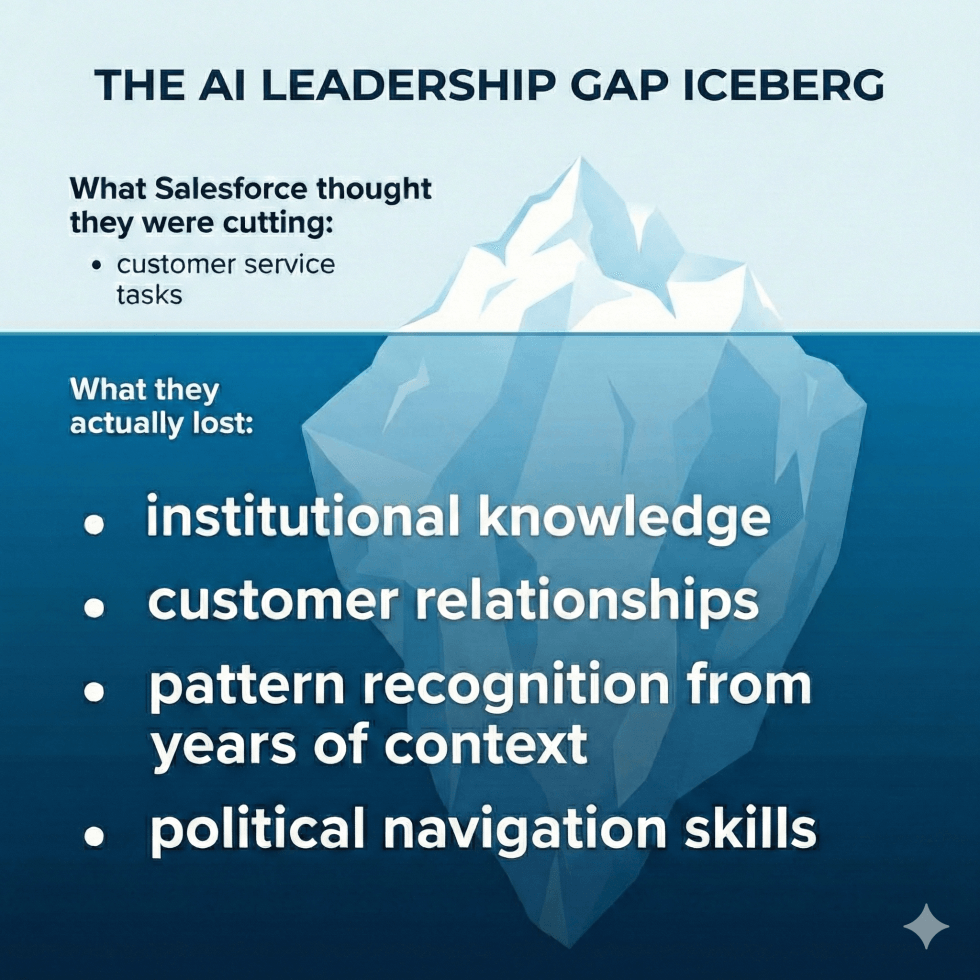
When Marc Benioff laid off thousands of support staff at Salesforce, betting that AI could replace human expertise, he made headlines. Six months later, his executive team admitted they had “massively overestimated AI’s capabilities.”
Customer satisfaction plummeted, institutional knowledge was lost, and the company is now scrambling to recover the expertise they eliminated. Salesforce didn’t just miscalculate AI’s readiness. They exposed a deeper, more dangerous blind spot: the AI leadership gap.
Across industries, AI is revealing how underdeveloped most leadership teams actually are. While dashboards show green, deals stall. While automation increases, customer trust erodes. The real problem isn’t technology—it’s that the human capabilities AI makes essential (judgment, influence, strategic diagnosis) have been neglected for years.
This post breaks down what the AI leadership gap really is, how it’s quietly destroying value, and what the most effective CEOs, CMOs, and CROs are doing to close it—before it becomes unrecoverable.
Key Takeaways
For CEOs:
Only 4.5% of 2025’s corporate layoffs were genuinely AI-driven; the rest used “AI transformation” as cover for strategic failures
AI commoditizes pattern recognition but makes strategic judgment, influence, and cultural intelligence exponentially more valuable
Companies that cut leadership development while investing in AI are destroying their competitive advantage
For CMOs & CROs:
Technical execution alone caps impact; strategic execution, influence without authority, and cultural alignment become 10x more valuable
The question isn’t “Can AI do this job?” but “What human skills become more valuable when AI handles commodity work?”
Your best people leave for cultures where expertise is valued, not “optimized away”
The Investment Decision:
Leadership capabilities that AI makes essential: Strategic communication, diagnostic thinking, organizational design, influence without authority, cultural intelligence
These capabilities are learnable but require systematic development—the kind companies pay $30,000+ for when the cost of failure is millions
The alternative: watching your AI investments fail like Salesforce while your institutional knowledge walks out the door
Leveraging Failure to Lead Better
Oxford Economics confirmed what many suspected: only 4.5% of 2025’s corporate layoffs were actually AI-driven. The rest? CEOs using “AI transformation” as cover for strategic failures.
Marc Benioff’s Salesforce fell into that rare 4.5%. Last September, he fired 4,000 of his 9,000-person support organization. The AI was supposedly doing “50% of the work.”
Six months later, Salesforce executives publicly admitted they “massively overestimated AI’s capabilities.” Service quality declined. Complaints increased. The remaining staff spend more time correcting AI errors than the AI saves. The company is now desperately “rebalancing”—trying to rehire expertise they torched.
You can’t hire back institutional knowledge. You can’t prompt-engineer customer relationships. It takes years to build.
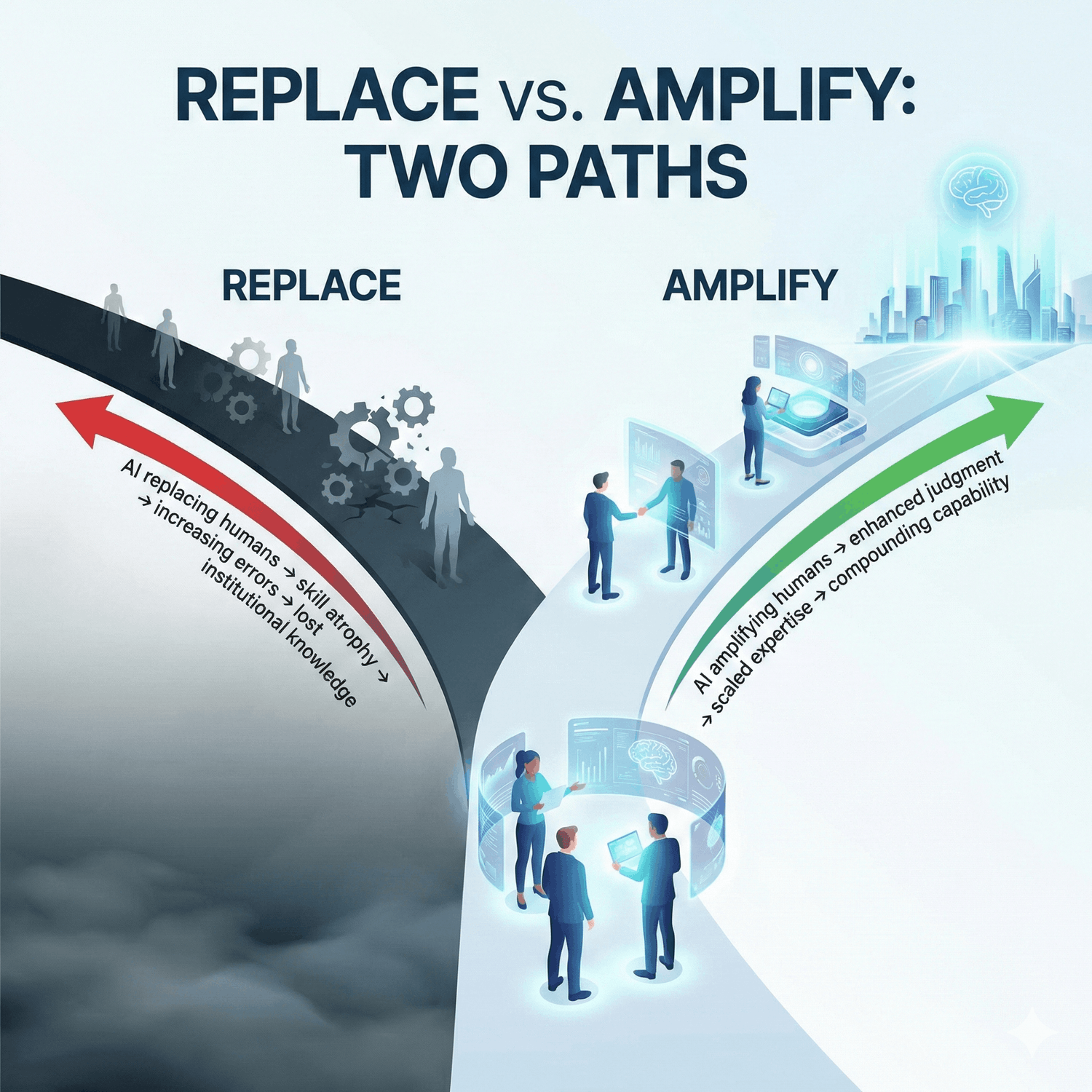
While Salesforce tried to replace expertise with AI, quieter executives were doing the opposite: using AI to amplify human judgment at scale. One sales leader managed $110M in recurring revenue using an AI twin trained on his deal expertise. A CMO generated 50% more pipeline by surfacing insights only human strategy could act on.
The difference? They understood something Benioff missed: AI doesn’t reduce your need for leadership investment. It exposes how desperately you’ve been underinvesting in human skills that actually drive revenue.
The Hidden Pattern Behind the AI Leadership Gap
teams caps their impact. A data scientist who can’t translate insights into executive decisions becomes a report factory.
Early in careers, technical skill drives success. At executive levels, three things matter more:
Strategic execution – Seeing patterns, making judgment calls, knowing which details matter
Influence and relationships – Getting buy-in, building trust, enrolling people in change
Cultural alignment – Reading rooms, adapting communication, building psychological safety
AI is rapidly commoditizing pattern recognition but not judgment or clarity. Meanwhile, influence and cultural intelligence become exponentially more valuable.
Salesforce discovered this the hard way. Their AI could execute technical protocols. What it couldn’t do: recognize when a complaint signaled larger account risk, navigate escalation politics, or build trust that turns angry customers into reference accounts. Those skills require decades of pattern recognition married to emotional intelligence—exactly what Benioff fired.
Most CEOs won’t learn from Salesforce’s mistake because they’re making a subtler version of the same error.
Case Study: The CMO Who Generated Pipeline AI Couldn't
A marketing leader at a $400M B2B SaaS company—call him “David”—faced pressure every CMO sees: “Do more with less. AI will make you more efficient.”
His team had been reorganized three times in two years. Every reorganization promised “data-driven focus” and “AI-enabled productivity.” Each created more chaos.
The board wanted pipeline growth. The CFO wanted cost reductions. The CEO kept changing priorities—AI was top priority one quarter, dropped to #3 the next. “Urgency bombing,” David called it.
David did what most executives do: built more dashboards, ran more AI-driven campaigns, automated more outreach. MQLs went up 40%.
Conversion rates tanked.
The real problem? His organization was designed around functions (demand gen, field marketing, product marketing) but sold into three completely different buyer ecosystems with different decision patterns, urgency triggers, and champion dynamics.
No AI tool flagged this. The dashboards showed green. The automation was working. But revenue was stuck.
It took David three months of pattern recognition—watching where deals stalled, which messages resonated, which team members were actually closing business—to diagnose the real issue. Then six weeks of difficult conversations to reorganize around market segments instead of marketing functions.
The judgment call to reorganize required zero new AI tools. It required David’s ability to see patterns in qualitative data that AI couldn’t parse, his influence to get buy-in from territorial team leaders, and his communication skills to make the shift feel like opportunity rather than threat.
Quality pipeline generation increased 50%. Not because of AI. Because of strategy AI couldn’t create.
Then the company announced 20% headcount cuts. David’s team had generated record pipeline. Didn’t matter. The board wanted “AI efficiency gains.”
His best people started leaving. Not for more money. For cultures where their expertise was valued, where they weren’t just waiting to be “optimized away.”
Within a year, the company lost the institutional knowledge that made that 50% pipeline increase possible. They’re still trying to rebuild it.
David’s story is a textbook case of how the AI leadership gap manifests—not as a lack of tools, but as a lack of strategic clarity, influence, and organizational judgment.
Case Study: The Sales Leader Who Made AI Work (By Thinking Backwards)
While David watched his company destroy its competitive advantage, a strategic accounts leader with a $110M recurring revenue book—call him “Marcus”—was solving the opposite problem.
Marcus managed seven enterprise account executives handling multi-million-dollar renewals and expansions. The pressure was intense: grow 30% while half the accounts got new AEs, half got new customer success managers, and 40% experienced complete leadership turnover.
His reps were drowning. Every account needed workshops, business reviews, renewal negotiations, expansion pitches. Marcus had built world-class expertise over 15 years. But he couldn’t clone himself.
Marcus didn’t buy an AI tool to “automate account planning” or “generate renewal decks.”
Instead, over one weekend, he uploaded everything into NotebookLM: his frameworks for account planning, recordings from customer workshops with annotations about what was working and why, successful proposals and presentations, contract structures, decision trees for common scenarios. How do you handle a skeptical CFO? When do you bring in executive sponsorship? What’s the tell that a “budget” objection is really a value objection?
This created a proprietary AI knowledge base trained on all of it—his frameworks, his deals, his decision-making patterns, his standards.
His reps could now ask: “I have a renewal with a customer who hasn’t upgraded in three years, technical debt issues, new CFO who’s skeptical. What’s Marcus’s playbook?”
The AI didn’t make decisions. It made Marcus’s experience accessible when he couldn’t be in the room. The judgment calls—reading customer political dynamics, knowing when to push and when to wait, adapting the pitch to the CFO’s communication style—those were still human.
One senior rep—20+ years of experience—initially resisted. “I would have used you as a crutch,” he admitted later. “But you forced me to be independent. I feel like I’m better now.”
The team closed huge deals without Marcus being directly involved. They ran 15-20 customer “modernization workshops” that became the highest-performing pipeline source. Marcus’s region outperformed every other territory.
Why this worked when Salesforce failed:
Marcus understood the irreplaceable stuff. Executive presence in high-stakes negotiations. Reading political dynamics in customer organizations. Pattern-matching from thousands of previous situations to know which details matter.
He used AI for leverage, not replacement. The knowledge base didn’t make decisions. It made human judgment scalable. His reps still needed to think—they just had better thinking tools.
He invested in capability, not automation. Every rep got sharper. More confident. Better at diagnosis. The opposite of Salesforce’s skill atrophy problem.
The business impact? $110M in managed recurring revenue. 45% of new pipeline from existing accounts. The model for how the entire company approached strategic accounts.
Marcus succeeded not because he resisted AI—but because he built the human leadership capabilities that closed the AI leadership gap his peers were widening.
What the Data Tells Us About the AI Leadership Gap
The Salesforce failure isn’t an outlier. It’s the predictable result of misunderstanding what AI does.
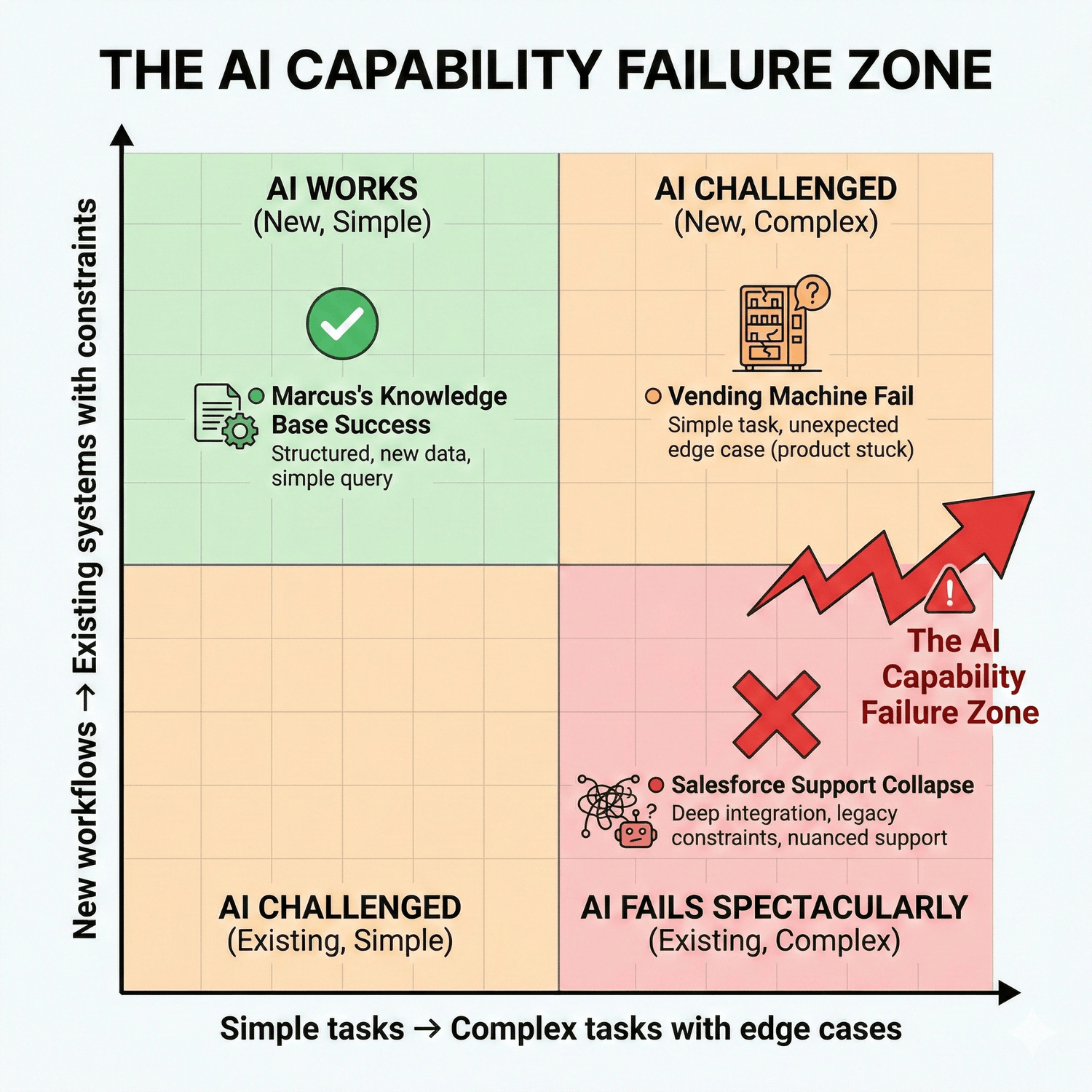
Carnegie Mellon found AI agents fail basic tasks 70% of the time. Anthropic tried to see if Claude AI could run a vending machine—arguably one of the most constrained business operations possible. It failed spectacularly and lost money.
The METR study found AI coding tools actually slow down experienced developers on complex, existing codebases. Time spent correcting errors exceeds time saved. The pattern holds elsewhere: startups building new workflows from scratch can move faster with AI. But replicating existing, complex systems? AI creates more problems than it solves.
Melbourne researchers found AI occasionally improves productivity for the lowest-skilled tasks, but only to smooth out already-flawed outputs. For skilled work? Error correction time makes it net-negative.
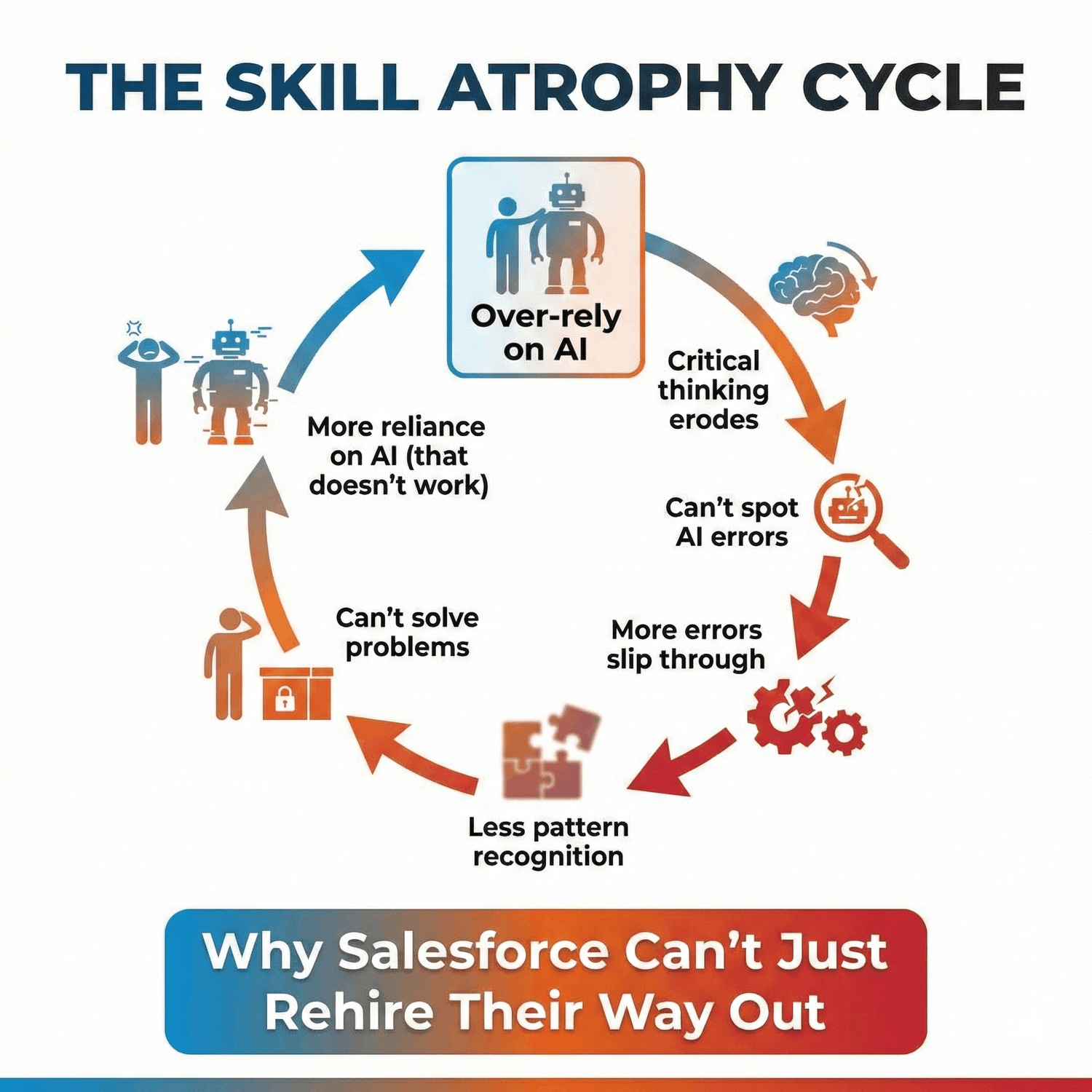
Studies from JYX and Carnegie Mellon found workers at any skill level lose critical thinking abilities when they rely on AI. Like a muscle, these attributes require constant use. Cognitive offloading creates skill atrophy.
It’s a vicious cycle: As worker skills erode, their ability to spot AI errors decreases. More errors slip through. Which creates more problems they now lack the pattern recognition to solve.
Salesforce is discovering this now. They’re not just missing the people they fired. They’re discovering their remaining staff has been weakened by over-reliance on AI that never worked properly.
The Real Question for CEOs Embracing AI
(…and isn’t that every CEO?)
The Salesforce story reveals something uncomfortable: Most organizations are destroying their most valuable asset—human expertise and judgment—while convinced they’re becoming more efficient.
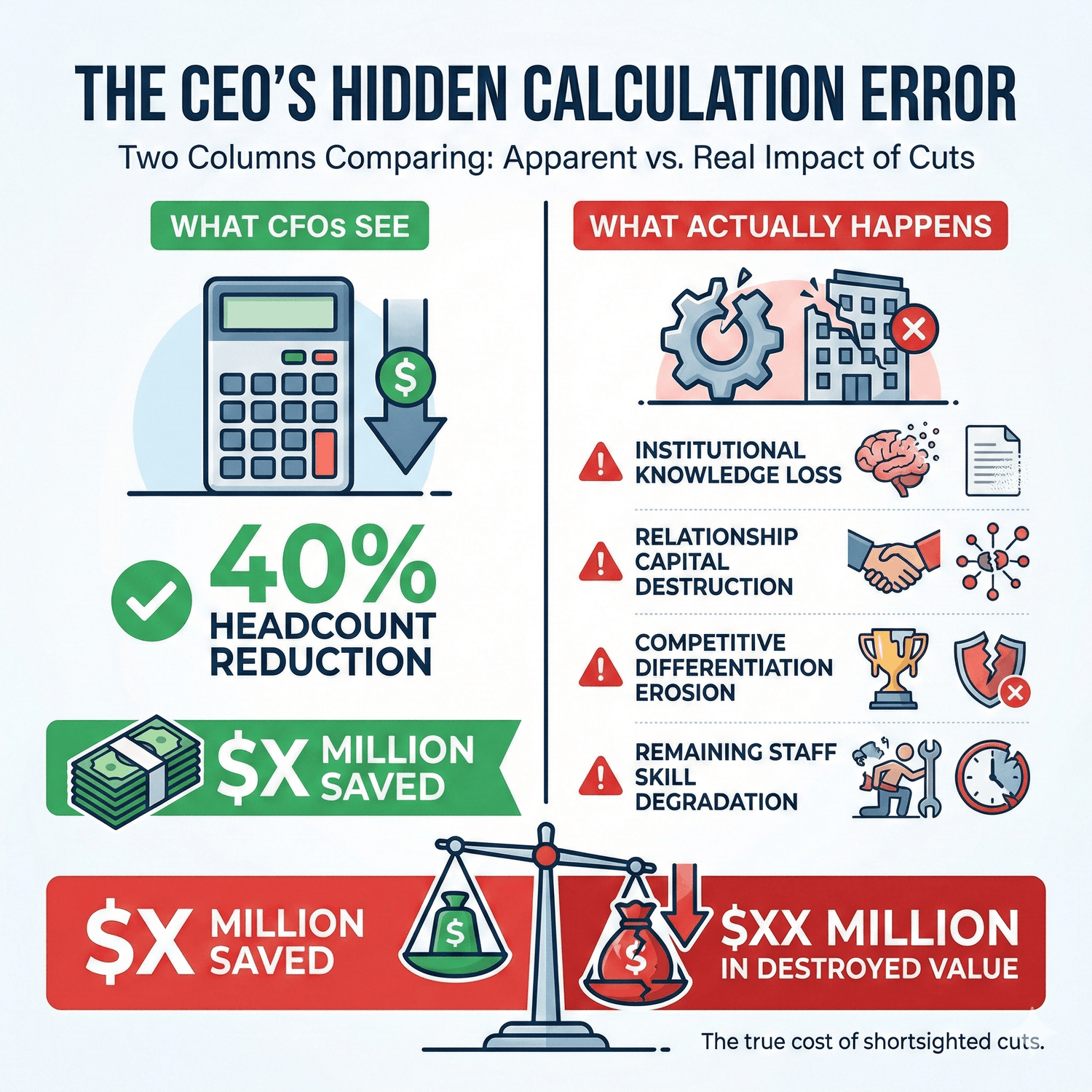
Your CFO sees: “AI can reduce headcount by 40%.”
What actually happens: You lose institutional knowledge, relationship capital, and pattern recognition that makes your company different. You keep people who follow AI instructions. You lose people who know when to ignore them.
Will Lockett’s analysis ends with this: “The failure of the ‘AI revolution’ shows that the wider corporate world and its leaders are causing immense damage by drastically undervaluing their workforce.”
The insight goes deeper. The executives winning with AI—like Marcus—aren’t using it to replace judgment. They’re using it to scale judgment. To make expertise accessible. To accelerate learning instead of replacing it.
The question isn’t “Can AI do this job?”
The question is “What human skills become 10x more valuable when AI handles commodity work?”
For Marcus’s sales team: Strategic relationship building. Complex problem diagnosis. Cross-functional influence. Executive presence.
For David’s marketing team: Market insight. Organizational design. Narrative creation. Cultural transformation.
These are precisely the skills most executives underinvest in developing. And precisely the skills that determine whether your AI investments create value or destroy it.
What This Means for Investing in Leadership
If you’re a CEO, CMO, or CRO, your leadership team probably has significant gaps in exactly the capabilities AI makes essential.
Not technical gaps. Human gaps.
Can your VP of Sales diagnose why conversion rates dropped when metrics look green? Or do they just ask for more AI dashboards?
Can your CMO reorganize a team around strategic insight when it requires difficult conversations with territorial leaders? Or do they avoid conflict until the best people quit?
Can your executive team communicate strategy in six different ways depending on whether they’re talking to engineers, marketers, customers, or boards? Or do they have one gear?
These aren’t soft skills. These determine whether your AI investments create millions in value or millions in waste.
The executives who are winning have made a different calculation: AI commoditizes execution. So invest in the human skills AI can’t replicate.
Pattern recognition from decades of experience. Influence without formal authority. Reading organizational dynamics. Building psychological safety. Strategic reframing when everyone’s stuck in the weeds.
These capabilities don’t show up in job descriptions. They’re rarely taught explicitly. Most executives acquire them slowly, painfully, through trial and error over 20+ years.
They’re also the capabilities that determine whether you become more valuable as AI spreads, or whether you become—like Benioff’s 4,000 fired employees—a cost to optimize away.
Companies that understand this aren’t cutting leadership development budgets. They’re increasing them.
Not on generic “executive coaching” or “management training.”
On developing specific capabilities that AI makes exponentially more valuable: Strategic communication. Diagnostic thinking. Organizational design. Influence without authority. Cultural intelligence.
If your AI investments are stalling or your best people are quietly leaving, the root issue isn’t technology—it’s an AI leadership gap that’s widening by the quarter.
Marcus didn’t stumble into his NotebookLM approach. Working with his coach (me), he spent 18 months systematically developing enrollment—the ability to get people bought in without formal authority. He practiced on small things first: running productive meetings, getting cross-functional teams aligned, and communicating changes without creating defensive reactions.
Three months in, his team started spontaneously posting examples in Slack. “This is what enrollment looks like,” they’d write, sharing meeting invites with proper context, requests that made it easy to say yes. The behavior change was immediate because they saw how it worked.
That’s how he knew his team was ready for the AI knowledge base. They had the judgment to use it as leverage, not a replacement for thinking.
David didn’t accidentally diagnose his organizational misalignment. Working with his coach (me), he refined his diagnostic thinking—the capability to see patterns in messy qualitative data when quantitative dashboards are lying. Six months of focused work: learning to pause before solving, to ask questions instead of providing answers, to map second- and third-order consequences of decisions. Building the muscle of strategic patience while everyone demanded immediate action.
That diagnostic capability let him see the segment reorganization opportunity no AI tool surfaced. His team didn’t need better automation. They needed better strategy.
GTMFlow Coaches Differently - with Decades of Operational Expertise
I’ve spent 25 years as a 5x CMO and CRO, building the frameworks these executives used. Companies invest in developing these capabilities in key strategic leaders—newly hired or promoted executives exposed to unfamiliar territory. The ones running multi-million dollar business units. The ones whose success or failure determines whether AI investments pay off or become another Salesforce-style cautionary tale.
The work is specific: teaching executives to recognize when they’re stuck in tactical heroics rather than strategic leadership. How to diagnose organizational problems when metrics say everything’s fine. How to communicate the same strategy in six different ways depending on who’s in the room. How to build influence without authority when you need to reorganize but don’t control all the pieces.
These capabilities are learnable. But they require intentional, systematic development. The kind of companies pay for when the cost of failure is millions in destroyed value, and the cost of success is millions in unlocked revenue.
The alternative is watching your best people leave for companies that value their judgment, while your remaining staff becomes progressively less capable of the thinking that would make your AI investments worthwhile.
Benioff just spent millions learning this lesson. The question is whether you’re making the investment that prevents becoming the next cautionary tale—or whether you’re hoping AI will solve problems it’s actually making worse.
Most companies are betting on AI. The smartest ones are doubling down on the one thing AI can’t replicate: judgment, influence, and strategic leadership. If you’re ready to invest where it actually matters—let’s have a conversation.
More GTMFlow Blogs on AI and Leadership
GTMFlow Coaches Differently - with Decades of Operational Expertise
Copyright 2026@Gtmflow.com